Sher “Teri Aankhon Ke Siwa Duniya Mein Rakha Kya Hai” is a famous line from the Nazam, “Mujh Se Pehli Si Mohabbat Meri Mehboob Na Maang” by Faiz Ahmad Faiz.
The poem begins as a love poem but pivots sharply – the poet tells his beloved he can no longer offer her the same blind devotion, because the suffering of the world has made it impossible to look away. Sung by Noor Jehan in the 1962 film “Qaidi”, it became one of the most beloved pieces of Urdu poetry ever written.
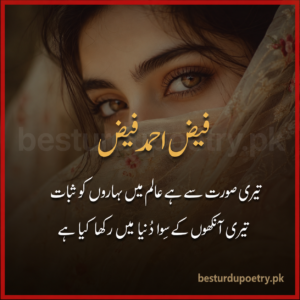
teri surat say hai aalam main baharon ko sabat
teri aankhon ke siwa duniya main rakha kiya hai
مکمل نظم / Full Poetry – Mujh Se Pehli Si Mohabbat
مجھ سے پہلی سی محبت مری محبوب نہ مانگ
میں نے سمجھا تھا کہ تو ہے تو درخشاں ہے حیات
تیرا غم ہے تو غمِ دہر کا جھگڑا کیا ہے
تیری صورت سے ہے عالم میں بہاروں کو ثبات
تیری آنکھوں کے سِوا دنیا میں رکھا کیا ہے
تو جو مل جائے تو تقدیر نگوں ہو جائے
یوں نہ تھا میں نے فقط چاہا تھا یوں ہو جائے
اور بھی دکھ ہیں زمانے میں محبت کے سِوا
راحتیں اور بھی ہیں وصل کی راحت کے سِوا
ان گنت صدیوں کے تاریک بہیمانہ طلسم
ریشم و اطلس و کمخواب میں بنوائے ہوئے
جا بہ جا بکتے ہوئے کوچہ و بازار میں جسم
خاک میں لتھڑے ہوئے خون میں نہلائے ہوئے
جسم نکلے ہوئے امراض کے تنوروں سے
پیپ بہتی ہوئی گلتے ہوئے ناسوروں سے
لوٹ جاتی ہے ادھر کو بھی نظر کیا کیجے
اب بھی دل کش ہے ترا حسن مگر کیا کیجے
اور بھی دکھ ہیں زمانے میں محبت کے سِوا
راحتیں اور بھی ہیں وصل کی راحت کے سِوا
مجھ سے پہلی سی محبت مری محبوب نہ مانگ
Teri Aankhon Ke Siwa Duniya Mein Rakha Kya Hai – Faiz Ahmad Faiz
Mujh se pehli si muhabbat mere mehboob na maang
Maine samjhaa tha ke tu hai to darakhshaan hai hayaat
Tera gham hai to gham-e-dehar ka jhagdaa kyaa hai
Teri surat se hai aalam mein bahaaron ko sabaat
Teri aankhon ke siwaa duniyaa mein rakhkhaa kya hai
Tu jo mil jaaye to taqdir nigoon ho jaaye
Yoon na thaa maine faqat chaahaa thaa yoon ho jaaye
Aur bhi dukh hai zamaane mein muhabbat ke siwaa
Raahatein aur bhi hain vasl ki raahat ke siwaa
Anginat sadiyon ki taareeq bahemaanaa tilism
Resham-o-atlas-o-kamkhwaab mein bunvaaye hue
Ja-ba-ja bikte hue koochaa-o-baazaar mein jism
Khaak mein lithade hue, khoon mein nehlaaye hue
Jism nikle hue amraaz ke tannooron se
Peep behti hui galte hue naasooron se
Laut jaati hai udhar ko bhi nazar, kya keeje?
Ab bhi dilkash hai tera husn, magar kya keeje?
Aur bhi dukh hai zamaane mein muhabbat ke siwaa
Raahatein aur bhi hain vasl ki raahat ke siwaa
Mujh se pehli si muhabbat mere mehboob na maang
Teri Aankhon Ke Siwa – Meaning & Explanation
The line “Teri aankhon ke siwa duniya mein rakha kya hai”- “What is there in this world besides your eyes?” – is one of the most quoted lines in all of Urdu poetry, by Faiz ahmad Faiz. On the surface, it’s pure romantic devotion: the beloved’s eyes are everything, the whole world compressed into a single gaze.
But Faiz doesn’t let that feeling stand.
The nazm “Mujh Se Pehli Si Mohabbat Meri Mehboob Na Maang” opens with the poet recalling how he once believed love was enough – that if he had his beloved, nothing else mattered. Her sorrow was his only sorrow. Her beauty gave the world its spring. Her eyes held everything worth holding.
Then the poem breaks. Faiz turns to the world outside – bodies sold in streets, skin rotting with disease, centuries of darkness woven into silk and gold. He can’t unsee it. His gaze keeps returning to that suffering, even as he admits his beloved is still beautiful.
The tension is the whole point. “Aur bhi dukh hain zamaane mein muhabbat ke siwaa” – “There are other sorrows in the world besides love” – is Faiz’s confession that personal love, however real, cannot be the only thing a conscious person lives for. The poem is about the moment a romantic becomes a humanist.
This is what makes “teri aankhon ke siwa poetry in urdu” so enduring – it’s not just a love poem. It’s a reckoning.
FAQs
What is the meaning of "Teri Aankhon Ke Siwa Duniya Mein Rakha Kya Hai"?
Literally, it means "What is there in this world besides your eyes?" - an expression of total romantic devotion. In the context of the full nazm, it represents the poet's former state of mind, before he was awakened to the world's suffering and realized love alone couldn't be everything
What is the full name of this nazm?
The full name is "Mujh Se Pehli Si Mohabbat Meri Mehboob Na Maang" (مجھ سے پہلی سی محبت مری محبوب نہ مانگ), which translates as "Don't ask me, my beloved, for that first love of mine." The line "teri aankhon ke siwa duniya mein rakha kya hai in urdu" is one of its most famous verses, and the poem is also known by this line as a shorthand title.